
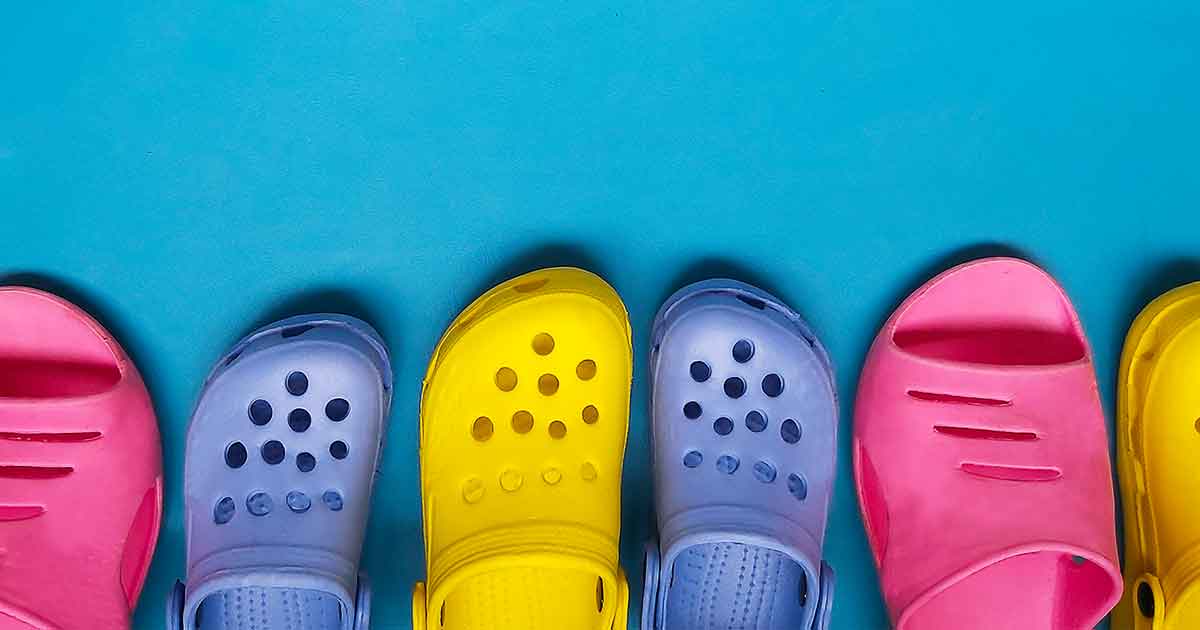
Why It’s Time to Rethink Those Comfy Crocs
If you’re like many people, you probably own a pair of Crocs—or at least have slipped them on and thought, “Wow, these are comfortable.” They’re easy to clean, come in bright colors, and are marketed as a safe, lightweight, breathable option made from EVA foam. But if you’re trying to live a low-tox lifestyle, Crocs deserve a closer look. Behind the soft soles and colorful designs, there’s a toxic truth: these shoes might be undermining your health in ways that are hard to ignore.
Crocs Are Still Plastic—No Matter What the Marketing Says
Let’s start with what Crocs are made of. The brand refers to its proprietary material as Croslite™, a closed-cell resin often lumped into the same category as EVA (ethylene-vinyl acetate) foam. This synthetic material is lightweight and cushioned, but far from natural or non-toxic. EVA foams like this are a form of plastic. They may be soft and squishy, but they’re also a product of petrochemical manufacturing—a process that brings many environmental and health concerns.
Even worse, companies often greenwash these materials, playing up EVA’s recyclability or “safety” without mentioning the toxic additives that make it wearable and flexible. These include plasticizers, stabilizers, colorants, and antimicrobial treatments—all of which can introduce potentially hazardous chemicals into your daily life.
Hormone Disruptors Hiding in Plain Sight
The soft foam of Crocs isn’t just a cozy place for your feet. It also carries phthalates and other hormone-disrupting chemicals that can leach out over time. Phthalates are used to make plastic flexible, but they’re also linked to a host of health problems, from reproductive harm to developmental delays. Multiple studies have found that many mass-produced plastic shoes, including Crocs, contain these compounds. Some have also detected the presence of heavy metals like lead and cadmium, which can accumulate in the body over time and are known to be neurotoxic, especially in children.
Consistent exposure to hormone-disrupting chemicals from footwear could be hazardous for kids and teens, whose endocrine systems are still developing. And let’s be honest—Crocs are marketed heavily to kids, with cartoon charms, rainbow colors, and sizes for even the tiniest feet. If you’re trying to minimize exposure to environmental toxins for your family or yourself, what you wear matters as much as what you eat or clean your house with.
Barefoot in Plastic: The Absorption Problem
Most people don’t think about their feet being one of the most absorbent parts of their body. They’re covered in sweat glands and rich with capillaries. When you slide your bare feet into a pair of plastic-based shoes, especially in warm or humid conditions, you create a perfect storm for chemical absorption. Heat, moisture, and direct skin contact all help mobilize whatever’s in the material—phthalates, dyes, flame retardants, heavy metals—and allow those substances to pass through your skin barrier.
This isn’t some fringe theory. Skin absorption is a well-established route of exposure for many chemicals. Transdermal drug patches use the same principle. The difference? Those are delivering medication. Your Crocs may be delivering toxins.
No Support, All Risk: The Structural Problem
Even if you don’t care much about toxins, foot health is another issue worth considering. Crocs offer no arch support, ankle stability, or structure for natural foot movement. While they might feel great for a few minutes or around the house, prolonged wear can lead to problems like plantar fasciitis, knee pain, and spinal misalignment.
Your body’s foundation is your feet. Shoes that compress the toes, throw off your posture, or allow for excessive pronation can have a ripple effect on your whole musculoskeletal system. Combine that with the chemical exposure, and it’s easy to see why these casual clogs might not be the harmless footwear you thought they were.
Better Footwear Alternatives Exist
Thankfully, you don’t have to choose between going barefoot and exposing yourself to toxins. Solid alternatives exist—shoes made from natural materials like cork, vegetable-tanned leather, organic cotton, or even natural rubber. Look for brands focusing on zero-drop soles, promoting natural foot mechanics, and avoiding synthetic dyes, glues, and foams.
Choose brands that publish lab results and have transparent sourcing so you can be confident in what you’re putting on your body.
Final Thoughts: It’s Time to Step Up
Ultimately, Crocs may seem like a small detail in the big picture of your wellness journey. But health is built on the sum of small choices—what you eat, breathe, clean with, and yes, wear. Footwear made of synthetic, plastic-based foam that contains hormone disruptors and heavy metals doesn’t belong in a truly non-toxic lifestyle. Especially not when safer, more supportive, and just-as-comfy alternatives are available. So if you’re ready to level up your low-tox life, it might be time to kick the Crocs to the curb. Your feet—and your whole body—will thank you.
References:
- D’Août, K., Elnaggar, O., Mason, L., Rowlatt, A., & Willems, C. (2025). Footwear choice and locomotor health throughout the life course: A critical review. Healthcare (Basel), 13(5), 527. https://doi.org/10.3390/healthcare13050527
- Kim, L., Kim, D., Kim, S. A., Kim, H., Lee, T. Y., & An, Y. J. (2022). Are your shoes safe for the environment? Toxicity screening of leachates from microplastic fragments of shoe soles using freshwater organisms. Journal of Hazardous Materials, 421, 126779. https://doi.org/10.1016/j.jhazmat.2021.126779
Keep updated on latest posts
-

3 Kids’ Clothing Types I’d Think Twice About at Target
Kids’ clothing seems simple until you start looking at what actually goes into making a garment perform a certain way. A T-shirt can be designed…
-

The Cream Cheese Ingredient You May Want to Rethink
Cream cheese seems like one of those foods that should be simple. Milk, cream, salt, maybe a culture, and that’s about it. But flip over…
-

Could Choosing Different Fruits and Vegetables Support Fertility?
When you’re trying to improve fertility, the conversation usually turns to hormones, supplements, sleep, stress, exercise, alcohol, and overall diet. There’s another piece worth considering,…
-

Ricotta Raspberry Toast: An Easy 5-Minute Breakfast
Some mornings you want something that feels a little special without any actual effort. This is that breakfast. Creamy ricotta, sweet-tart raspberries, and a scatter…
One swap a week
Every week, one small change worth making, why it matters, and where to get it. Two minutes, then back to your life.