
BPA-Free Doesn’t Mean Chemical-Free: What’s on Your Receipt?
That little receipt you grab after buying groceries, filling up your car, or picking up coffee probably isn’t something you think twice about. You take it, put it in your wallet, or throw it away.
Here’s something worth knowing: some thermal paper receipts contain bisphenol chemicals that can transfer directly to your skin. And if you’ve been choosing “BPA-free” products to reduce exposure to endocrine-disrupting chemicals, there’s an important detail you may be missing.
BPA-free doesn’t mean bisphenol-free.
In many cases, BPA has simply been replaced with another chemical from the same family, most commonly bisphenol S, or BPS. Research has raised concerns about BPS because, despite being marketed as a safer alternative, it can interact with biological systems in ways that raise similar questions about endocrine and metabolic health.
The label doesn’t always tell the whole story.
What Is BPA and Why Does It Matter?
BPA (bisphenol A) is an industrial chemical used for decades in certain plastics and epoxy resins. It’s classified as an endocrine-active chemical, meaning it can interfere with the body’s normal hormonal signaling.
This matters beyond reproductive health. Hormones help regulate metabolism, growth, development, energy balance, thyroid function, and many other processes throughout the body. Concerns about BPA led manufacturers to develop “BPA-free” alternatives, which sounds reassuring until you look at what replaced it.
The BPA-Free Problem: Meet BPS
When consumers became more aware of BPA, manufacturers began replacing it with BPS (bisphenol S).
Chemically, BPS isn’t identical to BPA, but it belongs to the same broader family of bisphenol compounds. Research has found that BPS can also exhibit endocrine activity. A review by Thoene and colleagues examined the potential health effects of BPS and other bisphenols, highlighting concerns about their hormonal and metabolic effects.
The more useful question to ask isn’t “Is this BPA-free?” It’s “what replaced it?”
This applies far beyond receipts; it’s the right lens for evaluating any product that has removed a chemical from its formulation.
Why Thermal Receipts Contain Bisphenols
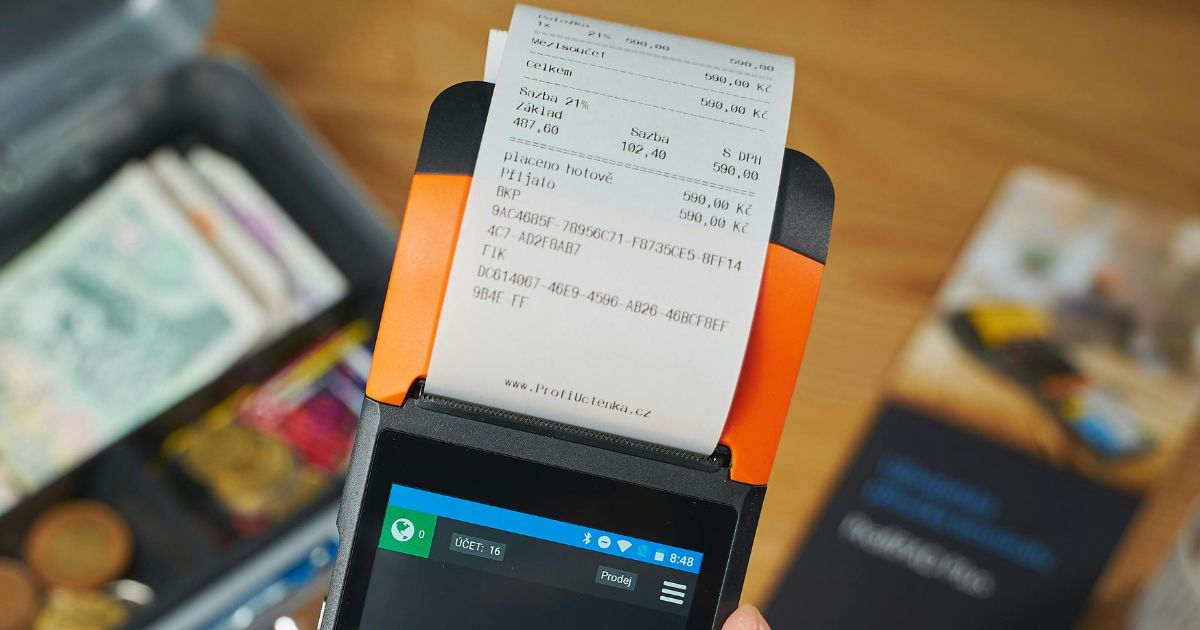
Most modern receipts aren’t printed with conventional ink. Thermal receipt paper uses heat-sensitive chemicals embedded in or coated onto the paper. When the paper passes through a thermal printer, a chemical reaction produces the visible text and images.
That chemical coating can contain bisphenol compounds in some formulations, and because it sits on the surface of the paper, direct skin contact becomes a meaningful exposure pathway.
Research has specifically investigated dermal exposure to bisphenols from thermal paper. A study by Liao and colleagues found that thermal paper could be an important source of human BPS exposure, particularly as BPS replaced BPA in more formulations. Their research suggested that thermal paper accounted for more than 88% of the estimated BPS exposure in the population evaluated under their exposure assumptions.
That figure reflects the methodology of a specific study and shouldn’t be read as universal. But the directional finding is significant: a small piece of paper can represent a disproportionate source of exposure when you’re handling it repeatedly.
Who Has the Most Exposure?
Exposure varies widely depending on how often someone handles receipts.
Grabbing one or two receipts a week is a very different exposure pattern from handling hundreds every day. Cashiers, retail and restaurant workers, bank employees, and anyone whose job involves routine contact with thermal paper may have substantially higher cumulative exposure.
How receipts are handled also matters. Holding them for extended periods, folding them, keeping them in pockets or wallets, or touching them while eating all affect the exposure picture. Reducing unnecessary contact is a relatively low-effort way to reduce one consistent source of exposure.
What About BPS-Free Thermal Paper?
Some receipts are now marketed as BPA-free or use alternative chemical developers. That’s a positive trend, but it also illustrates why “BPA-free” isn’t a reliable endpoint.
A product can be free of BPA while containing other chemicals that are less studied, or that carry their own potential concerns. This is part of a broader pattern in consumer chemical regulation: chemicals are sometimes replaced before we have a complete understanding of their long-term effects.
The practical takeaway isn’t to find the perfect replacement receipt. It’s to reduce unnecessary contact altogether when easy alternatives exist.
Simple Habits That Reduce Receipt Exposure
Choose digital receipts when available. Most businesses now offer receipts by email or text. This is the most complete solution: no physical thermal paper at all.
If you take a receipt, minimize handling. Hold it by the back rather than the printed, coated side. Keep contact brief.
Don’t handle receipts before eating. Wash your hands with soap and water after handling thermal paper and before eating, especially if you handle large quantities during the workday.
Be thoughtful about hand sanitizer timing. Research suggests that alcohol-based hand sanitizers can increase dermal absorption of bisphenol compounds, potentially altering how chemicals move from paper onto the skin. If possible, wash your hands with soap and water immediately before handling receipts, and again afterward.
Consider gloves for occupational exposure. If your job requires handling large quantities of thermal paper throughout the day, this is worth taking more seriously.
Keep receipts away from children. Kids don’t need to hold or play with receipts. If one is grabbed while shopping, take it away and wash hands before any food contact.
The Bigger Lesson About “BPA-Free” and Similar Labels
The receipt issue is a good example of why marketing labels aren’t a reliable shortcut for safety.
“BPA-free.” “Natural.” “Clean.” “Non-toxic.” These words can sound reassuring while telling you very little about what’s actually in a product.
The more useful questions:
- If BPA has been removed, what replaced it?
- If a product is marketed as chemical-free, what does that actually mean?
- What evidence is the manufacturer relying on?
You don’t have to become a chemist to make smarter choices. You just need the habit of looking past the front-label claim.
Frequently Asked Questions
Do thermal paper receipts contain BPA or BPS? Many thermal receipts contain bisphenol compounds, historically BPA, and increasingly BPS, as manufacturers have switched formulations in response to consumer concern about BPA. The chemical is present in the coating on the paper’s printed surface and can transfer to skin through direct contact. A study by Liao and colleagues identified thermal paper as a significant source of BPS exposure, sometimes accounting for a large proportion of the estimated total BPS exposure in the population studied.
Is BPS safer than BPA? Not necessarily. BPS was introduced as an alternative to BPA. Still, research has found that BPS can also exhibit endocrine activity, meaning it may interact with the body’s hormonal signaling in ways that raise similar concerns. A review by Thoene and colleagues examined potential health effects of BPS and other bisphenols and highlighted concerns about hormonal and metabolic effects. “BPA-free” labeling does not mean a product is free from all bisphenol chemicals or from endocrine-active compounds generally.
How do bisphenols from receipts get into your body? The primary exposure pathway from thermal receipts is dermal absorption, in which chemicals transfer from the paper’s coated surface onto the skin and are absorbed through it. Research has also raised concerns about hand-to-mouth transfer, where chemicals on the hands end up on food or enter the body through the mouth. Using hand sanitizer before handling receipts may increase dermal absorption, so washing with soap and water afterward is preferred over sanitizer alone.
Who is most at risk from thermal receipt exposure? People with the most frequent and prolonged contact with thermal paper carry the highest exposure burden. This includes cashiers, retail and restaurant workers, bank employees, and anyone whose job routinely involves handling receipts throughout the day. Occasional receipt handling represents a very different level of exposure than daily occupational contact. Reducing unnecessary handling is particularly relevant for those in high-contact roles.
What is the safest way to handle a receipt? The simplest options in order of effectiveness: opt for a digital receipt (email or text) to avoid thermal paper entirely; if taking a paper receipt, use gloves or hold it by the back rather than the printed side; keep contact as brief as possible; wash hands with soap and water after handling thermal paper and before eating. Avoid using hand sanitizer immediately before handling receipts, as some research suggests this may increase dermal absorption of bisphenol compounds.
Should children avoid touching receipts? Yes. Children’s developing systems can be more sensitive to endocrine-active chemicals, making unnecessary exposure worth reducing. If a child grabs a receipt while shopping, simply take it back, dispose of it, and wash their hands before any food contact.
References:
- Dueñas-Moreno, J., Mora, A., Kumar, M., Meng, X. Z., & Mahlknecht, J. (2023). Worldwide risk assessment of phthalates and bisphenol A in humans: The need for updating guidelines. Environmental International, 181, 108294.https://doi.org/10.1016/j.envint.2023.108294
- Roslan NS, Lee YY, Ibrahim YS, Tuan Anuar S, Yusof KMKK, Lai LA, Brentnall T. Detection of microplastics in human tissues and organs: A scoping review. Journal of Global Health. 2024;14:04179. doi: 10.7189/jogh.14.04179
Keep updated on latest posts
-
BPA-Free Doesn’t Mean Chemical-Free: What’s on Your Receipt?
That little receipt you grab after buying groceries, filling up your car, or picking up coffee probably isn’t something you think twice about. You take…
-
Tuna Pinwheels: An Easy Packable School Lunch
Some of the best lunchbox wins are the ones that make ordinary food feel like a treat. That is exactly what these pinwheels do. Instead…
-

How to Pack a Cleaner School Lunch: Non-Toxic Swaps That Actually Make a Difference
Packing a school lunch seems simple: food in a container, drink, snack, done. But when you start looking at what that food actually touches for…
-
Best Healthy Costco Finds: 3 Non-Toxic Foods Worth Buying
Looking for healthy Costco finds with clean ingredients? You’re not alone. Every month, Costco introduces dozens of new snacks, frozen meals, and convenience foods claiming…
One swap a week
Every week, one small change worth making, why it matters, and where to get it. Two minutes, then back to your life.