
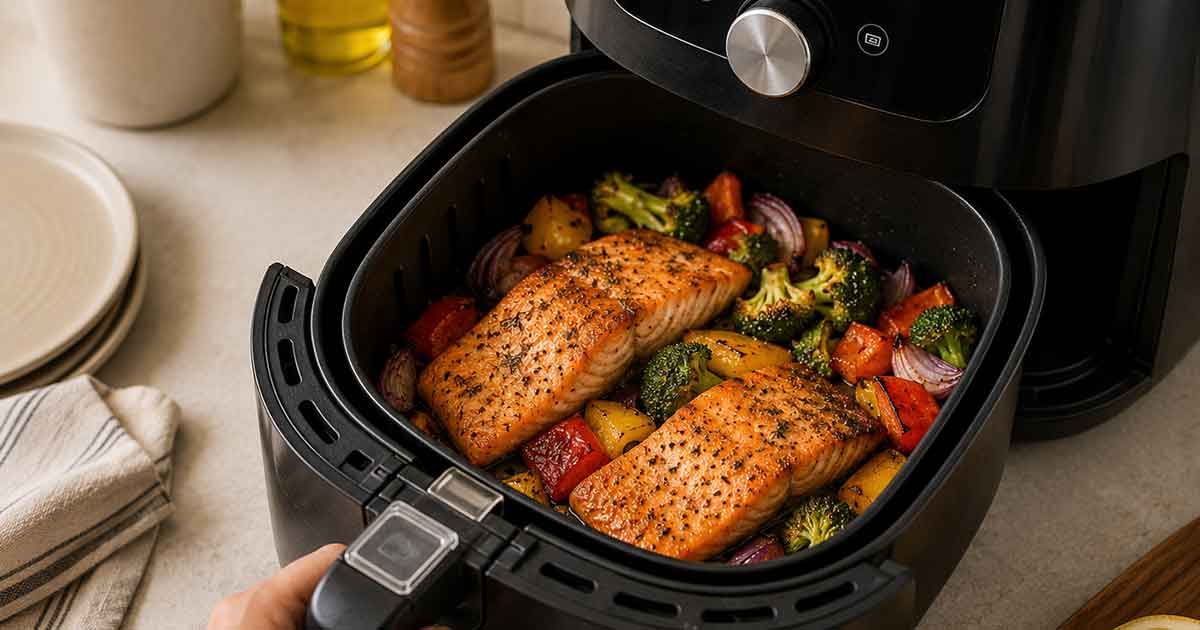
How to Choose a Non-Toxic Air Fryer: What I Look for Before Buying
Air fryers have become one of the most popular kitchen appliances for good reason: they’re fast, convenient, energy efficient, and produce great results with less oil than traditional frying.
But walk into any large-appliance section, and the conversation is almost entirely about cooking capacity, wattage, presets, and price. One thing that rarely comes up is what the interior of the cooking chamber is actually made of.
That’s the first thing I look at before buying any air fryer.
The food you cook comes into direct contact with heated surfaces and circulating hot air. If that interior is coated with questionable nonstick materials, the convenience may come with unnecessary chemical exposure that compounds over thousands of cooking cycles.
Here’s exactly what I look for, and what I avoid.
The Biggest Red Flag: Black Nonstick Interiors
The easiest thing to check is also the most important: the color and material of the cooking surface.
Many air fryers use black nonstick coatings on the basket, trays, or cooking chamber. Manufacturers don’t always specify the exact coating used, but these surfaces are commonly made of fluoropolymer-based materials, the same chemical family as Teflon (PTFE).
The PFAS concern. Although older compounds like PFOA have largely been phased out of nonstick manufacturing, many modern coatings still belong to the PFAS family or use related fluorinated chemistry. PFAS, often called “forever chemicals”, are extraordinarily persistent. They break down very slowly in the environment and in the body, and scientific research has linked them to immune system effects, hormone disruption, elevated cholesterol, developmental issues, and increased cancer risk with long-term exposure.
Under normal cooking conditions, intact nonstick coatings may remain relatively stable. But high temperatures, scratches, and years of use cause coatings to deteriorate over time, at which point the question of what’s transferring into food becomes more relevant, not less.
Since stainless steel alternatives are available at comparable prices, I prefer to avoid nonstick coatings altogether. If you open an air fryer and see a fully black cooking surface, that’s usually enough for me to move on.
Why Stainless Steel Is the Right Choice
Stainless steel has been used in professional kitchens for decades for straightforward reasons: it’s durable, corrosion-resistant, and doesn’t depend on a chemical coating for its cooking surface.
Unlike nonstick surfaces, stainless steel doesn’t peel, chip, or degrade over time. There’s no coating to wear away. The surface that touches your food on day one is the same surface touching it years later.
Does stainless steel require a little more cleaning? Sometimes. That’s the tradeoff, and it’s an easy one to make.
When shopping for an air fryer, I look for:
- Stainless steel cooking basket or trays
- Stainless steel interior walls
- Stainless steel racks
- The more stainless steel, the better
Check the Box, Not Just the Features
Most shoppers compare cooking capacity, wattage, preset programs, and price. I check the packaging.
One thing worth looking for: Proposition 65 warnings
California’s Prop 65 requires businesses to warn consumers when products may expose them to chemicals the state has identified as causing cancer, congenital disabilities, or reproductive harm. A Prop 65 warning doesn’t automatically mean a product is dangerous during normal use; companies often include it as legal caution around trace amounts or manufacturing processes.
That said, if I’m comparing two nearly identical air fryers and one carries a Prop 65 warning while the other doesn’t, I’ll choose the one without it. It’s one more data point that informs the decision.
More Features Don’t Mean a Better Appliance
Many newer air fryers advertise dozens of cooking modes: air fry, bake, toast, broil, roast, dehydrate, reheat, and proof bread, some even connect to smartphone apps.
Those features can be useful. But they’re not my priority.
A simpler appliance made from safer materials will always be a better daily-use kitchen tool than one packed with extra functions but coated with nonstick surfaces I’d rather avoid. Performance matters. Materials matter more.
One Model That Gets It Right: Cuisinart Stainless Steel Air Fryer Oven
One air fryer that consistently checks the right boxes is the Cuisinart stainless steel air fryer oven.
Unlike most compact basket-style models, this uses a stainless-steel interior with stainless-steel racks and trays rather than a black nonstick cooking chamber. It also offers a larger cooking capacity, useful for preparing multiple servings or cooking a full meal at once.
Features like dehydrating trays and convection baking are useful bonuses. But the primary reason it stands out is straightforward: stainless steel cooking surfaces instead of nonstick coatings.
There are other stainless steel air fryers on the market worth comparing, but this is a reliable reference point for what the material standard should look like.
Quick Checklist Before You Buy
When you’re standing in the appliance aisle:
- Open the door and look at the cooking Surface: is it black nonstick or stainless steel?
- Check packaging for Prop 65 warnings
- Confirm the basket, trays, and racks are stainless steel
- Compare materials across similar models, not just price and features
- Think about durability over years of use, not just day-one convenience
Frequently Asked Questions
Are air fryers with a nonstick coating safe? Most nonstick coatings on air fryers belong to the PFAS family of fluorinated chemicals or use related chemistry. While intact coatings may be relatively stable at normal cooking temperatures, high heat, scratches, and years of use can cause deterioration over time. PFAS compounds are persistent in the body and environment and have been linked to various health concerns with long-term exposure. For a daily-use appliance, choosing stainless steel over nonstick coatings is a straightforward way to avoid this concern entirely.
What is the safest air fryer material? Stainless steel is the safest and most durable material for air fryer cooking surfaces. It doesn’t require a chemical coating, doesn’t peel or chip over time, and has been used for decades in professional kitchens without the health concerns associated with fluoropolymer-based nonstick surfaces. When evaluating any air fryer, check whether the basket, trays, racks, and interior walls are stainless steel rather than coated with nonstick material.
What does a Prop 65 warning on an air fryer mean? California’s Proposition 65 requires businesses to warn consumers when products may expose them to chemicals identified as causing cancer, congenital disabilities, or reproductive harm. A Prop 65 warning on an air fryer doesn’t automatically mean the product is unsafe during normal use; companies often include it as a legal precaution around trace amounts of listed chemicals or manufacturing byproducts. However, when comparing similar models, choosing one without a Prop 65 warning is a reasonable preference when available.
Is the Cuisinart air fryer non-toxic? The Cuisinart stainless steel air fryer oven is one of the better options for health-conscious buyers because it uses stainless steel interior surfaces, racks, and trays rather than black nonstick coatings. It avoids the fluoropolymer chemistry associated with most conventional nonstick air fryer baskets. As with any appliance, checking the specific model’s materials before purchasing is worthwhile, since product lines vary.
Can nonstick air fryer coatings release toxic fumes? At very high temperatures, particularly above 500°F, fluoropolymer-based nonstick coatings can begin to break down and release fumes. Air fryers typically operate in the 350–400°F range during normal use, which is below the threshold where rapid degradation occurs in most cases. However, damaged, scratched, or significantly worn coatings can degrade at lower temperatures, and the long-term accumulation of PFAS compounds from coated cookware and appliances is a broader concern independent of acute fume exposure.
Why does stainless steel require more cleaning than nonstick? Stainless steel doesn’t have a chemical coating designed to prevent food from sticking, so some foods may adhere more than they would to a nonstick surface. Light oiling of stainless steel trays before cooking helps significantly. Soaking in warm, soapy water loosens most of the residue without much scrubbing. The extra cleaning step is the primary tradeoff for using a surface that doesn’t degrade over time and doesn’t depend on fluorinated chemistry to function.
References:
- DeWitt, J. C., Goldenman, G., Lohmann, R., Ng, C. A., & Wang, Z. (2025). Emerging toxicological awareness of per- and polyfluoroalkyl substances: The rising concern over “forever chemicals.” Disease Models & Mechanisms, 18(11), dmm052647.https://doi.org/10.1242/dmm.052647
- Nicole W. A Wide Reach: California’s Prop 65 and Reduced Chemical Exposures Across the United States. Environ Health Perspect. 2024 Dec;132(12):124003. doi:10.1289/EHP16435. Epub 2024 Dec 17. PMID: 39688694; PMCID: PMC11651356.
- Zhang X, Yu C, Wang P, Yang C. Microplastics and human health: Unraveling the toxicological pathways and implications for public health. Frontiers in Public Health. 2025;13:1567200. doi: 10.3389/fpubh.2025.1567200
- Ali Sultan SA, Ahmed Khan F, Wahab A, Fatima B, Khalid H, Bahader A, Safi SZ, Selvaraj C, Ali A, Alomar SY, Imran M. Assessing Leaching of Potentially Hazardous Elements from Cookware during Cooking: A Serious Public Health Concern. Toxics. 2023;11(7):640. Published 2023 Jul 24. doi:10.3390/toxics11070640. PMID: 37505605; PMCID: PMC10386729.
Keep updated on latest posts
-

Best Coffee Creamers at Target: Cleanest Options
If you are buying coffee creamer at Target, the ingredient list matters more than the pretty packaging on the front of the bottle. I went…
-

3 Ways I Use Thyme for Coughs and Colds Every Fall
When fall rolls around, and coughs, congestion, and sore throats start making their way through the house, I reach for an herb that has been…
-
Can Rosemary Aroma Improve Memory and Focus?
Rosemary is usually thought of as something you throw into a pan with potatoes, chicken, or vegetables. But this familiar herb may have another interesting…
-

Homemade Chicken Feet Bone Broth for Dogs
A collagen-rich, joint-supporting bone broth made with two ingredients — safe, simple, and something your dog will genuinely go crazy for Chicken feet bone broth…
One swap a week
Every week, one small change worth making, why it matters, and where to get it. Two minutes, then back to your life.