
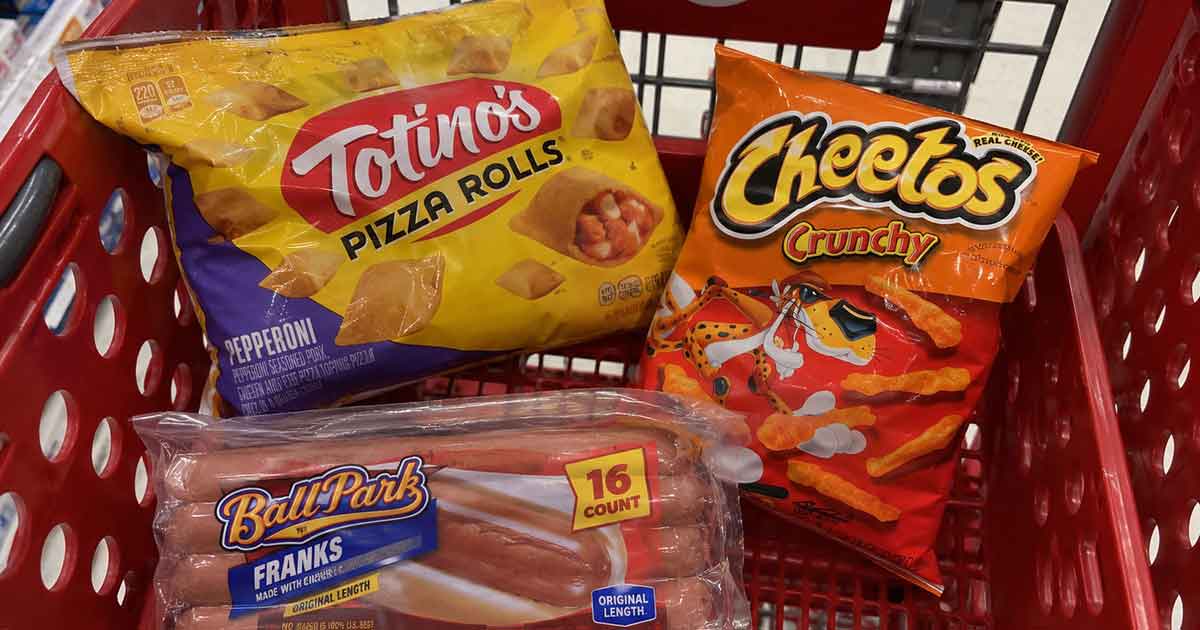
3 Target Grocery Items I’d Skip (and the Swaps I’d Grab Instead)
A quick grocery run can turn into a lot of label reading when you’re trying to make more thoughtful choices about what comes home with you. Some popular snacks and convenience foods contain artificial colors, additives, or ingredients worth a closer look. Here are three Target grocery items I’d leave on the shelf, and the alternatives I’d reach for instead.
Quick Overview: The Swaps I’d Make
- Totino’s Pizza Rolls → A frozen pizza made with real mozzarella and a shorter ingredient list. Totino’s lists imitation mozzarella cheese containing titanium dioxide in its ingredient information.
- Takis or classic Cheetos → Siete Habanero Hot Honey Kettle Cooked Potato Chips, made with potatoes, avocado oil, and a spicy-sweet seasoning without Red 40 or Yellow 6 in the listed ingredients.
- Conventional hot dogs → Applegate organic hot dogs made with grass-fed beef, if you want a different option. Keep in mind that hot dogs are still processed meat, even when they’re organic or made with grass-fed beef.
-
Totino’s Pizza Rolls: Look for Real Cheese Instead
Pizza Rolls are convenient, easy to share, and a familiar freezer staple. But take a look at the ingredient list for Totino’s Pizza Rolls, and you’ll find imitation mozzarella cheese, which may contain titanium dioxide, an additive used to impart a white color. The product’s ingredient information also lists preservatives and other additives.
Titanium dioxide became a bigger point of discussion in 2021, when the European Food Safety Authority (EFSA) concluded that it could no longer be considered safe as a food additive because concerns about potential genotoxicity could not be ruled out. That assessment is one reason I’d rather choose a product that doesn’t rely on it.
The swap I’d make: Grab a frozen pizza made with real mozzarella and a simpler ingredient list. Check the label for familiar ingredients such as tomatoes, mozzarella, flour, olive oil, herbs, and yeast. You can also add your own vegetables or other toppings at home.
-
Takis and Classic Cheetos: Choose Spicy Chips Without Artificial Dyes
Bright colors are part of what makes certain snack foods stand out on the shelf. But the vivid red and orange hues in some popular snacks can come from synthetic food dyes, including Red 40 and Yellow 6.
These dyes have drawn attention from policymakers, too. California’s AB 2316 restricts certain synthetic food dyes in foods served by public schools, including Red 40 and Yellow 6. The legislation reflects growing concern about the use of these colors in foods that children may regularly eat.
The swap I’d make: Siete Habanero Hot Honey Kettle Cooked Potato Chips. Their listed ingredients include potatoes, avocado oil, and a seasoning made with honey, paprika, habanero, garlic, and onion. Red 40 and Yellow 6 aren’t listed.
You still get the crunch and a kick of heat, but with a short, easy-to-read ingredient list. Just remember that a simpler ingredient list doesn’t make chips an everyday health food; they’re still a snack to enjoy in moderation.
-
Conventional Hot Dogs: Rethink the Processed Meat
Hot dogs are a classic for cookouts, quick dinners, and ball games. But conventional hot dogs are processed meat, and that’s a category worth paying attention to.
In 2015, the International Agency for Research on Cancer (IARC), part of the World Health Organization, classified processed meat as Group 1: carcinogenic to humans. This classification means there is sufficient evidence that consuming processed meat can cause cancer, particularly colorectal cancer.
The swap I’d make: Applegate organic hot dogs made with grass-fed beef. When shopping, check the specific package for its ingredients and certifications so you know exactly what you’re buying.
One important note: organic certification and grass-fed beef don’t change the fact that a hot dog is processed meat. If your goal is to reduce processed meat overall, you could also rotate in grilled chicken, a bean-based option, or a homemade burger made from unprocessed beef.
A Few Simple Rules for Smarter Grocery Swaps
You don’t need to memorize every additive or spend your entire shopping trip reading labels. Start with a few habits:
- Read the ingredient list. Product formulas can change, so check the package rather than relying on an old ingredient list online.
- Look for the specific ingredient you want to avoid. “Natural,” or “organic,” doesn’t automatically mean a product is free of every ingredient you may be trying to limit.
- Choose swaps you’ll actually enjoy. A more thoughtful grocery cart is one you can maintain, not one that leaves you frustrated or feeling deprived.
- Think about the overall pattern. Replacing a few frequently purchased foods can be more practical than trying to overhaul everything at once.
FAQs
Does EFSA’s 2021 decision mean titanium dioxide is banned everywhere?
No. EFSA concluded that titanium dioxide could no longer be considered safe for use as a food additive based on the evidence and uncertainties reviewed in 2021. Food regulations vary by country, and that conclusion should not be described as a worldwide ban.
Are Red 40 and Yellow 6 banned in all school meals?
No. California’s AB 2316 restricts specified dyes in food provided by public schools in that state. School food policies and timelines differ by jurisdiction, so check the applicable local rules.
Are organic, grass-fed hot dogs healthier?
Those labels describe how the ingredients are produced, but they don’t remove the concerns associated with processed meat. If reducing processed meat is your priority, consider making hot dogs an occasional food and choosing unprocessed alternatives more often.
Do I need to avoid every food additive?
Not necessarily. Additives serve different purposes, and their safety depends on the substance and the evidence behind it. A practical approach is to learn about the ingredients that matter most to you, read labels, and make realistic swaps that fit your household.
References:
- European Food Safety Authority (EFSA). “Titanium dioxide: E171 no longer considered safe when used as a food additive.” 2021.https://www.efsa.europa.eu/en/news/titanium-dioxide-e171-no-longer-considered-safe-when-used-food-additive
- California Legislative Information. AB 2316, Pupil nutrition: substances.https://leginfo.legislature.ca.gov/
- International Agency for Research on Cancer (IARC). “IARC Monographs Volume 114: Evaluation of consumption of red meat and processed meat.” 2015.https://www.iarc.who.int/news-events/iarc-monographs-volume-114-evaluation-of-consumption-of-red-meat-and-processed-meat/
- World Health Organization. “Carcinogenicity of the consumption of red meat and processed meat.”https://www.who.int/news-room/questions-and-answers/item/cancer-carcinogenicity-of-the-consumption-of-red-meat-and-processed-meat
Keep updated on latest posts
-
Baking Soda Beyond Baking: 4 Everyday Uses You Might Not Know About
Grab an extra box of baking soda next time you’re at the store, because baking is honestly one of the least interesting things it can…
-
3 Target Grocery Items I’d Skip (and the Swaps I’d Grab Instead)
A quick grocery run can turn into a lot of label reading when you’re trying to make more thoughtful choices about what comes home with…
-

Stuffed Delicata Squash with Sausage and Fresh Herbs
A one-pan fall dinner that uses the squash itself as the serving bowl, no peeling required, filled with savory sausage and fresh herbs for a…
-

Grounding and Earthing: Barefoot Walking and the Science
Hugging a tree barefoot might look a little out there, but there’s fascinating science behind reconnecting with the Earth. Grounding, also called earthing, is the…
One swap a week
Every week, one small change worth making, why it matters, and where to get it. Two minutes, then back to your life.