
Best Healthy Costco Finds: 3 Non-Toxic Foods Worth Buying
Looking for healthy Costco finds with clean ingredients? You’re not alone. Every month, Costco introduces dozens of new snacks, frozen meals, and convenience foods claiming to be healthier, higher in protein, or made with better ingredients. The problem is that “new” doesn’t necessarily mean healthy.
As an Environmental Scientist, I read every ingredient label before anything goes into my cart. The front of the package is designed to sell you a product. The ingredient list tells you whether it’s actually worth buying.
This month, three products stood out for all the right reasons. They rely on recognizable ingredients instead of artificial fillers, avoid many of the additives commonly found in packaged foods, and make eating real food a little more convenient.
Here are three Costco finds that officially earned a spot in my cart.
What Makes a Costco Product Healthy?
People often ask how I decide whether a packaged food is worth buying.
The truth is, I don’t have a complicated scoring system. I simply flip the package over and look at the ingredient list before anything else.
Here are a few things I look for:
- Short ingredient lists
- Whole-food ingredients
- Minimal added sugars
- No artificial flavors or colors
- No unnecessary preservatives
- Healthy fats, like extra virgin olive oil, instead of heavily refined oils whenever possible
- Organic ingredients when it makes sense
That’s exactly why these three products caught my attention.
-
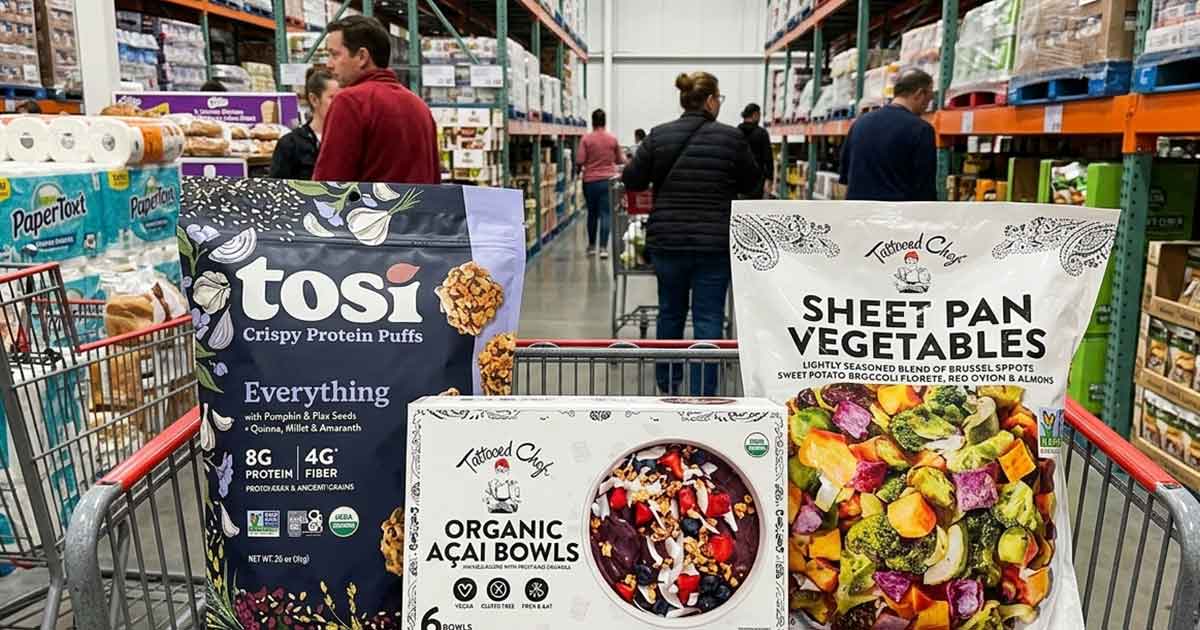
TOSI Crispy Protein Puffs
Protein snacks have become one of the fastest-growing categories in grocery stores. Unfortunately, many are little more than ultra-processed foods with a “high protein” label on the front.
It’s common to find protein chips and puffs made with protein isolates, artificial flavors, sugar alcohols, emulsifiers, and long ingredient lists that look more like a chemistry experiment than a snack.
That’s why I was pleasantly surprised by TOSI Crispy Protein Puffs.
Instead of relying on processed protein powders, they get their protein from seeds and ancient grains.
The ingredient list is refreshingly simple:
- Pumpkin seeds
- Cassava syrup
- Evaporated coconut blossom syrup
- Flaxseed
- Puffed brown rice
- Puffed quinoa
- Hemp seeds
- Puffed amaranth
- Puffed millet
- Sea salt
Each serving provides 8 grams of protein, along with naturally occurring fiber, healthy fats, and minerals from whole-food ingredients rather than fortified protein concentrates.
I also appreciate that they’re sweetened with cassava syrup and coconut blossom syrup instead of artificial sweeteners or sugar alcohols.
Why Ancient Grains and Seeds Are a Better Protein Source
One thing I like about this snack is that the nutrition comes from the ingredients themselves, not from isolates added later.
Pumpkin seeds naturally provide protein, magnesium, zinc, and healthy fats.
Flaxseed contributes fiber and plant-based omega-3 fatty acids.
Quinoa, amaranth, and millet are nutrient-dense ancient grains that provide complex carbohydrates, minerals, and additional protein.
That’s the kind of convenience food I don’t mind keeping in the pantry. Would I replace a meal with these? No. But as a quick snack after a workout, during a busy afternoon, or while traveling, they’re among the cleaner-packaged options I’ve found at Costco recently.
-
Tattooed Chef Organic Açaí Bowls
If you’ve shopped at Costco before, you may remember these. The Tattooed Chef Organic Açaí Bowls sold out and have finally returned to stores.
Frozen smoothie bowls can be surprisingly deceptive. Many contain added sugars, artificial flavors, syrups, stabilizers, and ingredients that turn what should be fruit into something closer to dessert.
These bowls take a much simpler approach. They’re made with certified organic ingredients and produced in Italy, where organic certification standards are among the strictest in the world.
What I like most isn’t that they’re organic, it’s that the ingredient list actually looks like something you could make yourself. That’s always a good sign. Instead of relying on artificial flavors or unnecessary fillers, these bowls focus on real fruit and simple ingredients. For busy mornings, that’s exactly what I want.
Why I Often Choose Organic Frozen Fruit
One question I hear a lot is whether organic frozen food is worth buying.
My answer depends on the food. When it comes to fruits that you eat regularly, I think organic can be a worthwhile investment if it fits your budget. Frozen fruit is picked at peak ripeness and frozen quickly, helping preserve flavor and nutrients. Choosing organic varieties may also reduce exposure to certain pesticide residues compared with conventionally grown fruit.
The bigger reason I like these bowls, though, is convenience. Let’s be honest: most of us don’t have time every morning to wash fruit, measure ingredients, and blend the perfect smoothie bowl from scratch. Having a frozen option made with recognizable ingredients makes healthy eating a lot easier. Products that help you eat more real food without adding a long list of artificial ingredients are worth paying attention to.
-
Tattooed Chef Organic Sheet Pan Vegetables
Convenience foods and vegetables don’t usually go together.
Walk down the frozen food aisle, and you’ll find plenty of vegetable blends covered in sugary sauces, refined oils, artificial flavors, gums, starches, and preservatives. While they may save time, they often turn a healthy side dish into a highly processed product.
That’s why these Organic Sheet Pan Vegetables immediately stood out.
The ingredient list is exactly what you’d hope to see:
- Organic Brussels sprouts
- Organic sweet potatoes
- Organic broccoli florets
- Organic red onion
- Organic zucchini
They’re lightly seasoned with:
- Organic extra virgin olive oil
- Sea salt
- Black pepper
That’s the entire ingredient list. No mystery spices. No “natural flavors.” No seed oil blends. No preservatives. It’s essentially a tray of vegetables that someone else already washed, chopped, and seasoned for you.
Why Frozen Vegetables Deserve More Credit
Frozen vegetables sometimes get a bad reputation, but nutritionally, they’re often an excellent choice. Most vegetables are frozen shortly after harvest, helping preserve many of their vitamins and minerals. They’re also incredibly practical.
Having vegetables ready to roast or sauté removes one of the biggest barriers to eating more produce: preparation time. If choosing frozen vegetables means you’re eating broccoli on a busy Tuesday instead of ordering takeout, that’s a win. The key is choosing frozen vegetables that still look like vegetables and not products covered in heavily processed sauces and additives.
How I Shop at Costco Without Falling for Marketing
Most of my decisions happen in less than a minute because I follow the same process every time. First, I ignore the front of the package. Words like “natural,” “high protein,” “made with real ingredients,” or “gluten-free” don’t automatically tell me whether a product is healthy.
Then I flip it over. The ingredient list tells the real story. If it’s short, recognizable, and built around whole foods, I’ll usually keep reading. If it’s packed with artificial flavors, preservatives, refined oils, gums, or ingredients I wouldn’t cook with at home, it usually stays on the shelf.
Nutrition labels matter, but ingredients come first. I’ve found that this simple habit eliminates most of the products I don’t want without having to memorize complicated nutrition rules.
The Bigger Picture
No packaged food is perfect. Even the cleanest Costco finds shouldn’t replace meals built around fresh vegetables, quality proteins, fruit, legumes, and minimally processed foods.
However, some mornings, you need breakfast in five minutes. Some afternoons, you need a snack that doesn’t come from a vending machine. Some evenings, you need vegetables that are already washed and ready to cook. Convenience isn’t the problem. Ultra-processing is.
When a packaged food makes it easier to eat real ingredients without adding a long list of unnecessary additives, I consider that a worthwhile upgrade. That’s exactly why these three products earned a place in my cart.
Frequently Asked Questions
What are the healthiest foods to buy at Costco?
Some of the healthiest Costco foods are products made with short ingredient lists and minimally processed ingredients. I look for foods built around whole grains, seeds, vegetables, fruit, and healthy fats rather than artificial flavors, preservatives, and highly refined ingredients.
Are Costco’s organic foods worth buying?
If they fit your budget, organic Costco products can be a great value. I tend to prioritize organic fruits and vegetables, especially foods we eat regularly, because they may reduce exposure to certain pesticide residues.
Are frozen vegetables healthy?
Yes. Frozen vegetables are typically harvested and frozen quickly, helping preserve nutrients. The healthiest options are those without sugary sauces, artificial flavors, or unnecessary additives.
How do you know if a packaged snack is healthy?
I always start with the ingredient list. I look for recognizable ingredients, minimal processing, and as few unnecessary additives as possible. A short ingredient list made from real foods is usually a good sign.
The Bottom Line
These three finds stood out because they rely on real ingredients instead of clever marketing. The TOSI Crispy Protein Puffs provide protein from seeds and ancient grains without relying on artificial sweeteners or protein isolates. The Tattooed Chef Organic Açaí Bowls are made with certified organic ingredients and offer a convenient breakfast option built around real fruit. And the Tattooed Chef Organic Sheet Pan Vegetables prove that frozen convenience foods don’t need a long ingredient list to taste good.
I don’t expect packaged foods to be perfect. My goal is simply to find products that make it easier to eat whole, minimally processed foods on busy days. These three do exactly that.
The next time you’re walking through Costco, don’t let the front of the package decide for you. Turn it over, read the ingredients, and let the label tell the real story. That’s the habit that consistently leads to better choices.
References:
- Vitale M, Costabile G, Testa R, D’Abbronzo G, Nettore IC, Macchia PE, Giacco R. Ultra-Processed Foods and Human Health: A Systematic Review and Meta-Analysis of Prospective Cohort Studies. Advances in Nutrition. 2024;15(1):100121. doi: 10.1016/j.advnut.2023.09.009. PMID: 38245358; PMCID: PMC10831891.
- Rahman, A., Baharlouei, P., Koh, E. H. Y., Pirvu, D. G., Rehmani, R., Arcos, M., & Puri, S. (2024). A comprehensive analysis of organic food: Evaluating nutritional value and impact on human health. Foods, 13(2), 208.https://doi.org/10.3390/foods13020208
- Ricciuto L, Fulgoni VL III, Gaine PC, Scott MO, DiFrancesco L. Intakes of added sugars, with a focus on beverages and the associations with micronutrient adequacy in US children, adolescents, and teens (NHANES 2003–2018). Nutrients. 2023;15(15):3285.https://doi.org/10.3390/nu15153285
- Goodman, M. J. (2017). The “natural” vs. “natural flavors” conflict in food labeling: A regulatory viewpoint. Food and Drug Law Journal, 72(1), 78–102. PMID: 29140655
- Hossain, M. S., Wazed, M. A., Asha, S., Hossen, M. A., Fime, S. N. M., Teeya, S. T., Jenny, L. Y., Dash, D., & Shimul, I. M. (2025). Flavor and well-being: A comprehensive review of food choices, nutrition, and health interactions. Food Science & Nutrition, 13(5), e70276.https://doi.org/10.1002/fsn3.70276
Keep updated on latest posts
-

3 Kids’ Clothing Types I’d Think Twice About at Target
Kids’ clothing seems simple until you start looking at what actually goes into making a garment perform a certain way. A T-shirt can be designed…
-
The Cream Cheese Ingredient You May Want to Rethink
Cream cheese seems like one of those foods that should be simple. Milk, cream, salt, maybe a culture, and that’s about it. But flip over…
-
Could Choosing Different Fruits and Vegetables Support Fertility?
When you’re trying to improve fertility, the conversation usually turns to hormones, supplements, sleep, stress, exercise, alcohol, and overall diet. There’s another piece worth considering,…
-
Ricotta Raspberry Toast: An Easy 5-Minute Breakfast
Some mornings you want something that feels a little special without any actual effort. This is that breakfast. Creamy ricotta, sweet-tart raspberries, and a scatter…
One swap a week
Every week, one small change worth making, why it matters, and where to get it. Two minutes, then back to your life.